Applying for a Vietnam tourist visa is easier when you choose the right entry option, prepare accurate documents and submit through an appropriate channel. This guide explains how to apply Vietnam tourist visa step by step, from checking eligibility and uploading passport details to paying the fee, tracking the result and preparing for arrival. You will also learn about available application methods, eVisa validity, HappyBook Visa service pricing, common reasons applications run into problems and what to consider if you may need more time in Vietnam.
What Is a Vietnam Tourist Visa?
A Vietnam tourist visa is an entry authorisation for foreign nationals visiting Vietnam for a holiday, sightseeing, cultural experiences or visits to friends and family. It does not automatically authorise employment, paid work or any activity requiring a work permit or another form of regulatory approval.
Travellers planning to apply Vietnam tourist visa should identify their intended length of stay, number of entries, arrival date and proposed border checkpoint before beginning the application. These details determine which visa option is suitable and how the form should be completed.

Who Needs to Apply for a Vietnam Tourist Visa?
Not every international traveller needs a visa before visiting Vietnam. The requirement depends on:
-
The nationality shown in the traveller’s passport.
-
The passport type provided.
-
The proposed length of stay.
-
The purpose of entry.
-
Applicable visa exemption regulations.
-
The conditions attached to a particular exemption.
-
The intended entry type.
A tourist visa is normally required when the traveller’s nationality is not covered by a visa exemption or when the planned stay exceeds the permitted visa-free period.
Vietnam’s Ministry of Foreign Affairs publishes information on visa exemptions. The permitted period can vary according to nationality and passport type, so travellers should review current rules rather than relying on information from a previous trip.
>>> Apply Evisa online at HappyBook Visa
Ways to Apply for a Vietnam Tourist Visa
The best application method depends on the traveller’s nationality, visa category, itinerary and available preparation time. For many international visitors, the most convenient way to apply for Vietnam tourist visa online is through the official eVisa system or with document-preparation assistance from a service provider.
1. Submit a Vietnam eVisa application online
The eVisa may be suitable for travellers who:
-
Are currently outside Vietnam.
-
Maintain a valid passport or eligible travel document.
-
Are not subject to an entry suspension.
-
Can provide the required images and personal details.
-
Plan to use an approved eVisa checkpoint.
The online process includes completing the form, uploading the passport biodata page and portrait, paying the government fee, receiving an application code and checking the result.
Key advantages:
-
The application can be completed from outside Vietnam.
-
A consular visit is generally unnecessary.
-
Applicants can choose between single and multiple entry.
-
A validity period of up to 90 days may be requested.
-
The result can be downloaded electronically.
Best suited to:
-
Independent tourists.
-
Applicants with a specific travel itinerary.
-
Applicants who have sufficient processing time.
-
Travellers comfortable submitting documents online.
2. Apply via a Vietnamese diplomatic mission
Travellers may contact the Vietnamese diplomatic mission responsible for their place of residence to confirm available visa categories, required documents, fees and submission methods.
The Ministry of Foreign Affairs’ visa portal instructs applicants to complete the required form, prepare the relevant documents and submit them to the selected Vietnamese consular authority. Requirements may vary depending on the visa category and processing office.
Key advantages:
-
Suitable for cases outside the standard eVisa process.
-
Applicants can obtain guidance from a consular authority.
-
May accommodate particular visa categories or circumstances.
Best suited to:
-
Travellers instructed to apply through a diplomatic mission.
-
Applicants who cannot use the eVisa process.
-
Cases that require further document review.
3. Apply through an inviting or sponsoring party
Some foreign nationals may need an eligible Vietnamese individual, company or organisation to submit an invitation or sponsorship request.
Travellers should not assume that every service advertised as a “visa on arrival” is a standard legal option for tourists. Visas issued at a border checkpoint are limited to circumstances recognised under Vietnamese immigration rules and should not be treated as a universal alternative to an eVisa.
Documents Required to Apply for a Vietnam Tourist Visa
Requirements can vary by nationality, visa category and application channel. A standard eVisa application commonly requires the following information.
1. A valid passport
The passport should:
-
Remain valid for the proposed journey.
-
Have a clear and readable biodata page.
-
Not be seriously damaged.
-
Display a readable passport number and identity details.
-
Be the passport the traveller intends to use for entry.
All visa details must match the passport presented during airline and immigration checks.
2. A passport biodata-page image
The scan or photograph should:
-
Show the entire biodata page.
-
Include all four corners.
-
Be free from glare.
-
Be clear and undistorted.
-
Keep all text visible and legible.
3. A recent portrait photograph
Official eVisa guidance requires applicants to upload a front-facing portrait without glasses, together with an image of the passport biodata page.
The portrait should:
-
Be recent.
-
The applicant’s face should not be obscured.
-
Have even lighting.
-
Be free from facial obstructions.
-
Not use filters that materially alter the applicant’s appearance.
4. Personal information
Required items may include:
-
Applicant’s full name according to the passport.
-
Date and place of birth.
-
Nationality.
-
Sex.
-
Occupation.
-
Residential address.
-
Email address.
-
Details of any other passport where requested.
5. Travel information
Frequently required information includes:
-
Purpose of entry.
-
Intended arrival date.
-
Intended departure date.
-
Proposed length of stay.
-
Entry checkpoint.
-
Exit checkpoint.
-
Place of stay in Vietnam.
-
Province or city of stay.
-
Host or contact information where applicable.
6. Additional required documents
The authority may ask for additional items based on the situation:
-
Proof of travel purpose.
-
Accommodation details.
-
A sponsor or invitation document.
-
Further itinerary information.
-
Documents clarifying information already submitted.
Step-by-Step Guide to Apply for a Vietnam Tourist Visa
Following a structured process can reduce avoidable errors and make the application easier to manage. HappyBook Visa can assist with document checks, application preparation and status monitoring, while travellers who need additional support with accommodation, transport or other arrangements for their Vietnam trip can explore travel services through HappyBook Travel. The final visa decision, however, always remains with the competent Vietnamese authority.
Step 1: Check your eligibility
Confirm:
-
Your eligibility for visa-free entry based on nationality.
-
Whether the visa-free period covers your entire trip.
-
Your required visa entry type.
-
Whether you are eligible to use the eVisa system.
-
Whether your checkpoint accepts eVisas.
-
Which validity dates you need to request.
Choose multiple entry if your itinerary requires you to leave Vietnam and return.
Step 2: Prepare your documents
Gather your passport, portrait, passport biodata-page image, email address and travel information.
Use clear images and ensure that all information is consistent. Avoid heavily edited photographs or images that no longer reflect your current appearance.
Step 3: Provide the required application details
Enter every detail exactly as it appears in the passport, paying particular attention to:
-
Family and given names.
-
Middle names.
-
Passport number.
-
Issue and expiry dates.
-
Nationality.
-
Purpose of entry.
-
Visa validity dates.
-
Entry type.
-
Proposed checkpoint.
The official eVisa instructions state that applications containing missing, incorrect or unidentifiable information may not be accepted.
HappyBook Visa can review the information before submission and identify common administrative errors.
Step 4: Pay the applicable fee
Once the form has been reviewed, complete payment through the method accepted by the government portal or service provider.
For a direct application through the official eVisa system:
-
Single-entry eVisa: US$25.
-
Multiple-entry eVisa: US$50.
The government fee is non-refundable if the visa is not granted.
Applicants using HappyBook Visa should confirm the total service charge, government fee, scope of assistance and estimated processing time before payment.
Step 5: Track the application
Keep a secure record of:
-
Your application code.
-
The registered email address.
-
The applicant’s birth date on the form.
-
Your payment receipt.
-
A reference copy of the submitted details.
The eVisa search facility uses the registration code, email address and date of birth to display the status or allow an approved visa to be downloaded.
Respond promptly if a correction or further information is requested.
Step 6: Download the visa and prepare for arrival
After approval:
-
Download the visa file.
-
Check the full name.
-
Check the passport number.
-
Confirm the nationality.
-
Review the validity dates.
-
Check the permitted entry type.
-
Review the checkpoint and other visa details.
-
Print at least one paper copy.
-
Save an electronic copy on your phone or email.
Official guidance instructs approved applicants to print the eVisa for entry to and exit from Vietnam.
Travellers whose plans may change should research how to extend tourist visa in Vietnam before their current permission expires. An extension is not automatic and depends on the traveller’s immigration status, available sponsor or requesting party, existing documentation and the decision of the immigration authority.
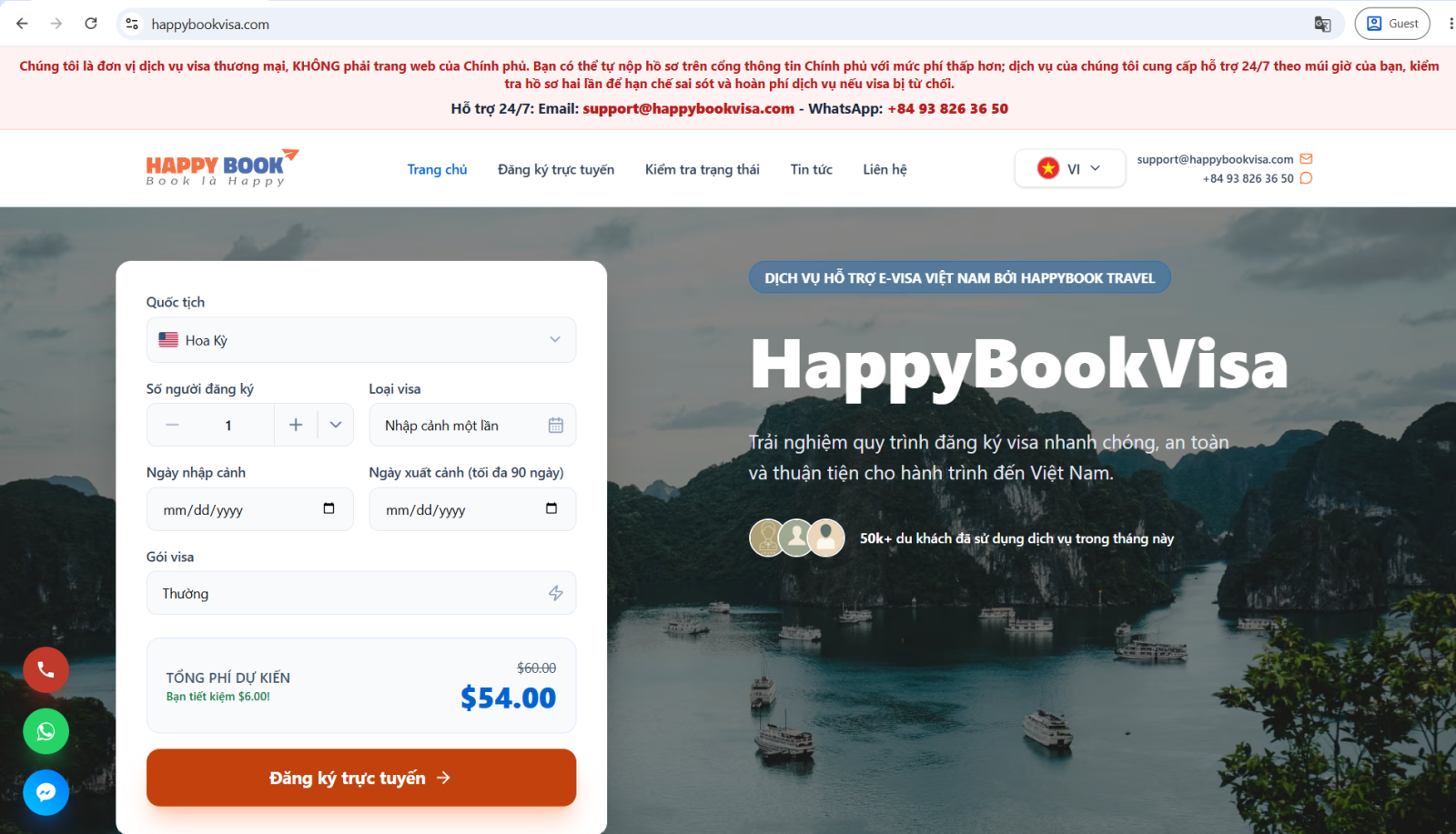
Vietnam Tourist Visa Pricing at HappyBook Visa
Travellers searching “how long is Vietnam tourist visa” are usually asking how much time an eVisa can cover. A Vietnam eVisa may be valid for up to 90 days and can allow either single or multiple entry. However, the actual validity is always determined by the dates printed on the approved visa.
The following rates apply to HappyBook Visa’s application-preparation and processing support for a multiple-entry eVisa with a requested validity of up to 90 days. According to the pricing information provided by HappyBook Visa, the government fee is included.
|
Service option |
Estimated processing time |
Total fee |
|
Standard |
5 - 7 days |
US$90.00 |
|
Urgent – 4 days |
4 days |
US$100.00 |
|
Urgent – 3 days |
3 days |
US$120.00 |
|
Urgent – 2 days |
2 days |
US$140.00 |
|
Urgent – 1 day |
1 day |
US$170.00 |
|
Urgent – 4 hours |
4 hours |
US$200.00 |
|
Urgent – 2 hours |
2 hours |
US$220.00 |
|
Urgent – 1 hour |
1 hour |
US$260.00 |
|
Saturday, Sunday or public-holiday support |
Case-dependent |
US$290.00 |
Common Reasons Why Tourist Visa Applications Are Rejected
Approval depends on the application assessment. An authority may decline to accept an application, request corrections or refuse the visa when the information or eligibility requirements are not satisfied.
1. Incorrect application details
Common errors include:
-
An incorrect passport number.
-
A wrong date of birth.
-
An omitted middle name.
-
Family name and first name are mixed up.
-
The wrong nationality.
-
An inaccurate passport expiration date.
-
An unsuitable stated purpose of entry.
-
Incorrect information compared with the passport.
Vietnam’s Ministry of Public Security states that eVisa information must be complete, accurate and truthful. An application may be refused if the authority identifies false declarations.
2. Incomplete application details or paperwork
An application may run into problems when:
-
No portrait is uploaded.
-
The passport image is missing.
-
Required sections are missing details.
-
No accommodation address is provided.
-
Checkpoint information is incomplete.
-
Payment is not completed.
3. Photos that fail to meet the requirements
Images may be unsuitable when:
-
The face is obstructed.
-
The photo shows the applicant wearing glasses.
-
The image is poorly lit or too bright.
-
The photograph is blurred.
-
Part of the passport page is missing.
-
Passport information is unclear or unreadable.
-
The portrait has been excessively edited.
4. Passport-related problems
An application may not be accepted if the passport:
-
Has expired.
-
Is seriously damaged.
-
Contains unclear or unreadable details.
-
Is not the passport intended for travel.
-
Does not meet the conditions for the requested visa.
The official eVisa conditions require the applicant to hold a valid passport or international travel document and not be subject to an entry suspension.
5. Incorrect entry type or validity dates
A single-entry visa is unsuitable for an itinerary that involves leaving Vietnam and returning. A validity period that starts too late or ends too early may also prevent the traveller from completing the planned journey.
6. Conflicting travel details
Additional reviews may apply in cases where:
-
The arrival date conflicts with the itinerary.
-
The accommodation address is incomplete.
-
The travel purpose is unclear.
-
The selected checkpoint does not match the route.
-
Host or contact information cannot be verified.
Travellers researching how to extend Vietnam tourist visa should review the visa expiry date as soon as the document is issued and seek advice well in advance. Waiting until the final day can leave insufficient time because temporary-stay extensions depend on eligibility, sponsorship arrangements, supporting documents and immigration approval.
Preparing accurate documents and selecting the right visa type can make it easier to apply Vietnam tourist visa without unnecessary delays. HappyBook Visa supports travellers with application checks, document preparation and status monitoring, while the final approval remains with the Vietnamese immigration authority.